
The Balcón del Mediterráneo in Benidorm is one of those places that let you understand the city at a glance. From the tip of the promontory that separates Levante and Poniente beaches, the view brings together sea, history, architecture and the urban skyline that has made Benidorm one of the most recognisable tourist destinations on the Costa Blanca.
Also known as the Castle Lookout (Mirador del Castillo) or Replaceta del Castell, this spot is part of the old town and can be visited at any time of year. Its elevated position lets you take in the two great bays, the small Mal Pas cove and much of the seafront. That is why it is a recommended stop both on a first visit and for those who return and want to rediscover the city in a different light.
Staying in Finestrat lets you combine this visit with the beach, gastronomy, mountain routes and other nearby points of interest, without depending on a single setting during your holiday.
What the Balcón del Mediterráneo lookout is and why to visit it
The Balcón del Mediterráneo lookout occupies the area where Benidorm’s old castle once stood. The complete fortress is not preserved, but the space keeps traces of its defensive past and a strategic position that explains why this point was so important for the town.
The current image is recognisable by its white balustrade, chequered paving and the steps that descend to the lower terrace. The contrast between the white of the architecture and the blue of the sea creates one of the most photographed panoramas on the Alicante coast, but the interest of the place goes beyond the photograph.
From the upper square you can read Benidorm’s coastal layout: Levante stretches to the east, Poniente opens to the west and, between the two, the old town keeps an urban scale different from the large buildings of the newer districts. It is a good spot to get your bearings before continuing the visit on foot.
The experience changes with the time of day. In the morning the Levante side stands out clearly; in the late afternoon, the light travels across Poniente bay; and at night, the lookout offers a different reading of the seafront promenade and the city’s illuminated skyline.
The history of the Balcón del Mediterráneo in Benidorm
The position of the promontory is no accident. During the 14th, 15th and 16th centuries there was a defensive fortress here meant to protect the settlement from raids by Algerian and Barbary pirates. Its height and visibility over the two bays made it easy to control the coast.
Over time, the castle lost its function and ended up abandoned. Today some remains of the old walls survive on the rock, while four cannons recall the military character of the enclave. This helps explain why the square is also popularly known as Replaceta del Castell.
The evolution of the space sums up part of Benidorm’s own transformation: from a defensive point facing the Mediterranean to an urban balcony open to visitors. The refurbishment and care of the surroundings have consolidated its value as a lookout, but the historic base is still present in the topography, in the preserved remains and in the layout of the old core.
It is worth walking around the square unhurriedly and observing both the horizon and the nearby details. The views are the main attraction, although the reading of the place is much more complete when it is connected to the city’s maritime and defensive history.
How to get to the Balcón del Mediterráneo from Finestrat
The Balcón del Mediterráneo is located in the Plaza del Castell, within Benidorm’s old town. The final stretch is done on foot along pedestrian-priority streets, something worth bearing in mind when planning your visit.
From Finestrat, the most flexible option is to drive to Benidorm and leave the vehicle in a public car park around the centre. Trying to reach the square itself is not practical, as access to the old core is conditioned by narrow streets, pedestrian areas and traffic regulations.
It is also possible to get closer by public transport and complete the route on foot. Before setting off, we recommend checking the current lines, stops and frequencies, especially outside high season or on public holidays.
Once in the centre, the most pleasant approach is to enter the old town through the Alameda area or from one of the seafront promenades. The streets climb towards the church of San Jaime y Santa Ana and then lead to the Plaza del Castell. The slope is moderate, but some streets have gradients and the paving typical of a historic area. If you want to organise a fuller day, our guide on what to see in Benidorm in three days helps you fit the lookout into a wider itinerary around the city.
The best time to visit the Balcón del Mediterráneo
There is no single right time. The choice depends on the kind of experience and the views you want to enjoy.
First thing in the morning
Early on there is usually a quieter atmosphere and clean light over the Levante area. It is a good option for those who want to stroll calmly, avoid the busiest hours and continue afterwards along the beach or the old town.
Late afternoon
The afternoon offers a particularly attractive perspective over Poniente. The lower light highlights the relief of the coast and softens the contrast with the buildings. In summer and at weekends there can be more visitors, so it is worth arriving with time to spare and enjoying the upper square too.
Night visit
At night, the strong point is the lighting of the seafront. The lookout stays lively and lets you contemplate the urban skyline from a central position. It is an easy plan to combine with dinner or a walk through the streets of the historic centre.
In any case, extra care should be taken on the steps and near the drops, especially if the paving is wet or you are visiting with children.
What to see in Benidorm from the lookout
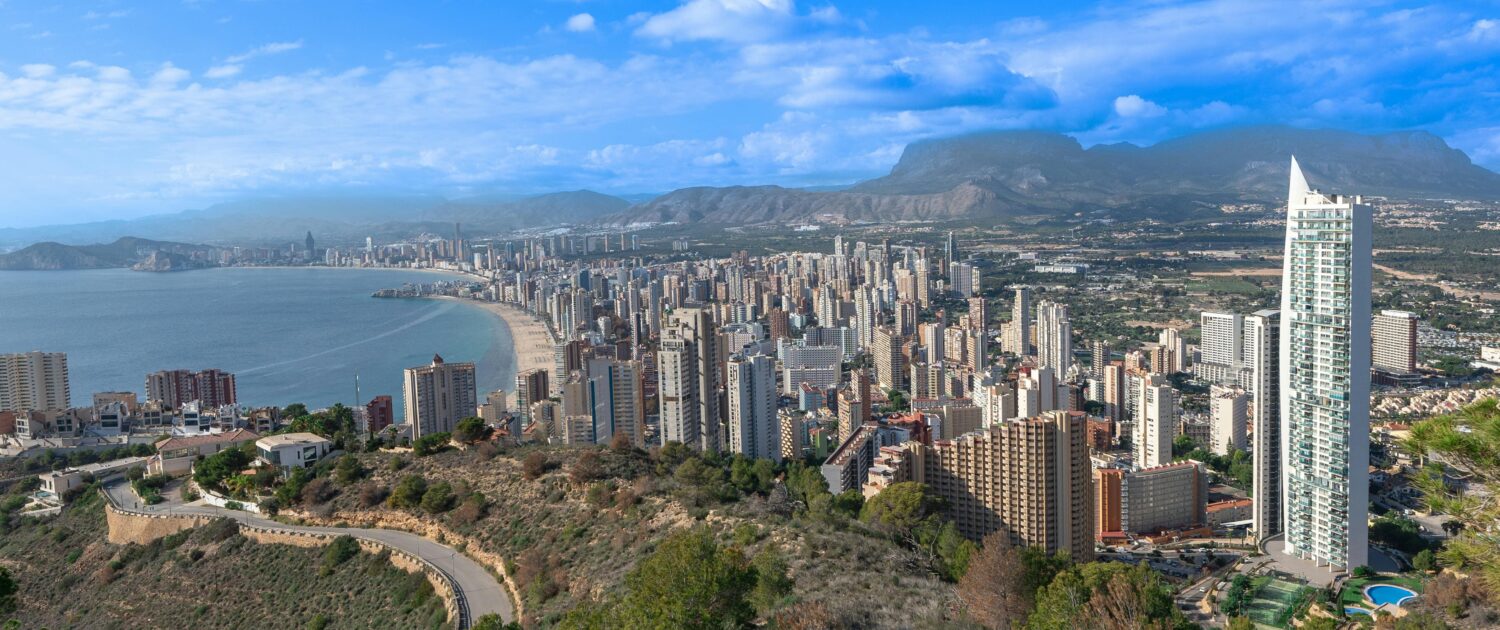
The value of the enclave lies in the breadth of the panorama. From a single point you can identify several of the essential spaces to see in Benidorm and understand how they connect to each other.
Poniente and Levante beaches
Poniente and Levante beaches occupy the two great arcs of sand on either side of the promontory. Although they are part of the same seafront, they have different orientations, urban landscapes and rhythms.
To the east lies Levante, recognisable by its lively promenade and the skyline of buildings that accompanies the beach. To the west appears Poniente, with a wide bay and a contemporary-design promenade that heads towards La Cala and Finestrat.
Between the two is the Mal Pas cove, small in size and protected by the position of the old town and the port. This succession of beaches helps you understand why the promontory has historically worked as a visual and defensive reference.
Benidorm Island and the sea horizon
On clear days, Benidorm Island stands out off the coast. Its silhouette helps open up the panorama beyond the urban front and recalls the city’s constant relationship with the sea.
Visibility depends on the weather, humidity and light. That is why it is not worth judging the visit solely by the chance of getting a particular photograph: even with clouds, the perspective over the beaches, the rock and the historic centre remains interesting.
The port and the Mal Pas cove
The southern and western side of the lookout lets you observe the port area and the small Mal Pas beach. From here you can clearly understand the transition between the old core, the maritime activity and the start of the Poniente front.
Those who want to extend the coastal route can then continue towards La Cala. Our guide on what to see in Cala de Finestrat brings together ideas for exploring this nearby area and rounding off the day by the Mediterranean.
Benidorm old town: a walk around the lookout
Benidorm’s old town deserves a walk of its own after visiting the Balcón del Mediterráneo. Its streets develop over the promontory and keep a more compact layout that contrasts with the modern avenues and large buildings of the rest of the city.
Next to the Plaza del Castell stands the church of San Jaime y Santa Ana, one of the architectural landmarks of the historic core. From its surroundings, narrow streets connect with the Alameda, the Plaza de la Señoría, the port area and the accesses towards Levante and Poniente.
An orderly way to explore it is to climb from one of the promenades, visit the church and the square, go down to the lower terrace of the lookout and return along the opposite side. This avoids repeating the same path and gives different perspectives over the coast.
Along the route you will find shops, terraces and streets linked to the city’s culinary tradition. If you want to choose where to continue the day, you can check our selection of places to eat in Benidorm.
Benidorm seafront promenade: how to continue the visit
After the lookout, the Benidorm seafront promenade lets you extend the route in either direction. You do not need to walk it all: just choose the stretch that best fits the time, temperature and type of plan.
Towards Levante, the promenade leads to one of the liveliest areas of the city, with a direct relationship between beach, dining and leisure. Towards Poniente, the route offers a wide perspective of the bay and gradually brings you closer to the La Cala area.
For a short route, it is practical to go down from the old town towards the port and walk along the start of Poniente. If you are looking for more of an urban atmosphere, you can go down the Levante side and continue along its seafront. In summer it is advisable to avoid the middle hours, carry water and use sun protection even on seemingly short walks.
Those who prefer to round off their stay with organised options can review the experiences available around Finestrat, an easy way to combine coast, culture and outdoor activities.
Practical tips for visiting the lookout
The visit is free and can easily be integrated into any route around Benidorm. Even so, a little planning helps you enjoy the surroundings more.
- Comfortable footwear: the old town streets include slopes, steps and different types of paving.
- Sun protection: the lookout is exposed and offers little shade at certain times of day.
- Water: especially recommended if you are going to continue along the beaches or the promenade.
- Mind the crowds: at sunset and during holiday periods a large number of visitors can gather.
- Watch the drops: the steps to the lower terrace and the closeness of the sea require supervision if visiting with children.
- Respect the surroundings: it is a historic space and one of Benidorm’s main tourist symbols.
The upper square lets you enjoy much of the views, while the lower balcony is reached by steps. People with reduced mobility should check the current access conditions and consider the upper part as the main observation point.
How to combine Benidorm with a stay in Finestrat
Finestrat works as a strategic base for getting to know Benidorm and other spots in the Marina Baixa. It lets you get close to the urban atmosphere, but also return to an area with beach access, mountain scenery and routes to nearby towns.
A day can start at the Balcón del Mediterráneo, continue through the old town and end in Poniente or La Cala. Another day can be devoted to the village of Finestrat, the area around Puig Campana or Villajoyosa. This variety is one of the area’s tourist strengths: sea, heritage, gastronomy and nature are all within a short distance of each other.
For stays of several weeks, having an apartment makes it easier to organise your visits with more flexibility, alternate excursion and rest days and adapt your schedule to the weather.
Frequently asked questions about the Balcón del Mediterráneo
The lookout raises common questions related to its location, access and the best way to include it in a route. These are the basic answers to prepare your visit.
Where exactly is the Balcón del Mediterráneo in Benidorm?
It is in the Plaza del Castell, on the promontory that separates Levante and Poniente beaches. It is part of the old town and stands next to the church of San Jaime y Santa Ana.
Are the Balcón del Mediterráneo and the Castle Lookout the same place?
Yes. The space is also known as the Castle Lookout (Mirador del Castillo) or Replaceta del Castell, names related to the defensive fortress that occupied this point for several centuries.
How much time do you need to visit the lookout?
You can take in the lookout in a short time, but we recommend setting aside at least part of the morning or afternoon to also explore the square, the church, the old town streets and one of the seafront promenades. The final time will depend on whether you add the beach, shopping or a gastronomic stop.
Can you visit with children?
Yes, but you need to supervise them on the steps, the areas with drops and the busiest points. Comfortable footwear and sun protection are especially important if the route continues through the centre and the beach.
Is it accessible for people with reduced mobility?
The upper square lets you contemplate the surroundings, but the characteristic lower terrace is reached by steps. We recommend checking the updated conditions before the visit and planning access along the streets with the gentlest slope.
What else can you visit nearby?
In the immediate area are the old town, the church of San Jaime y Santa Ana, the Mal Pas cove, the port and the Levante and Poniente promenades. From Finestrat you can also round off the getaway with La Cala, the historic village, Villajoyosa and natural spaces of the Marina Baixa.
The Balcón del Mediterráneo is not just about offering a good photograph. Its position, the history of the old castle and the panorama over the two beaches make it an excellent introduction to Benidorm and to the city’s relationship with the Mediterranean.